Coherence Co
A practice for leaders whose organisation is harder to run than it should be
Your strategy is clear, and yet the organisation still cannot turn that intent into delivery.Decisions keep escalating. Agreements dissolve outside the room. Your service delivery has not kept pace.The problem is rarely the people. It is how the organisation is set up to operate. And leaders rarely have the time or capacity to redesign it while running the work.
Coherence Co brings the capacity and judgement to do exactly that. The leader remains accountable; the work is done in partnership. System design, change and improvement.
Redesigning the conditions that capable leaders
are working around
What the work is
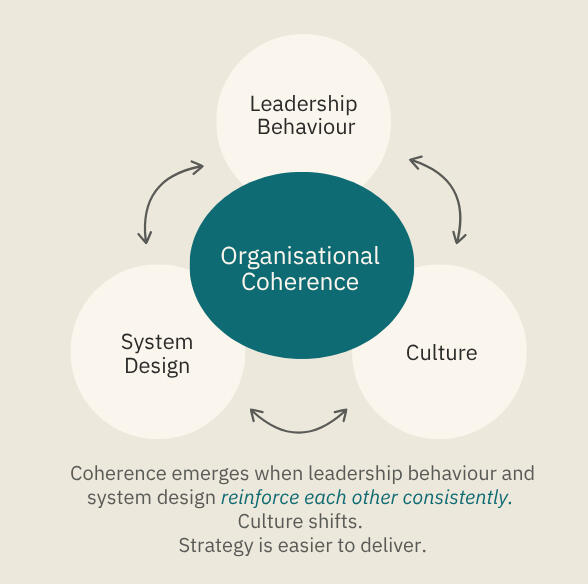
Most organisations treat leadership, systems and culture as three separate problems. The first is handled by HR or a coach. The second by an IT project. The third by a culture programme. The results do not compound, because the three are not being read as one.Coherence Co reads them as one. Leadership behaviour, system design and culture are one connected operating field. When they reinforce each other consistently, coherence is the result. When they pull in different directions, the organisation is harder to run than it should be.
Leadership → Systems → Culture = Coherence
The practice works across four types: adjustment, improvement, change and transformation. The type that fits your situation is determined in the first conversation, not before.Coherence does not arrive by default. It has to be designed in.
About
Built on twenty years of senior leadership inside complex organisations.
Now advising leaders navigating them.
How the work is builtSenior leadership work produces a particular kind of judgement when it is lived from the inside, not studied from the outside.Coherence Co draws on senior leadership accountability where delivery mattered and the margin for error was real. Public sector systems. Community partnerships. Elite sport delivery.That experience builds the ability to see what is actually happening in a system, and the discipline to name it without flinching.The work is also grounded in decades of research and practice. Systems leadership and organisational learning. The theory of action and the behavioural science of how change actually holds. Each sharpened by reading work as it is done, not as it is described.Track record
GM-level accountabilities inside a large public organisation through significant transition
Delivery for three Cricket World Cups and more than 100 international events annually at New Zealand Cricket
Built the conditions and capability for teams to redesign their own work in complex operating systems, including reducing a 700-step workflow to 25 steps
The first rūnanga–local council māhinga kai partnership model in the South Island, later replicated regionally.
The practice was founded by Michaela Rees and currently operates through her as adviser. More about Michaela at michaelarees.com.
Moving organisations from overload and reaction to
clearer decisions, steadier leadership and reliable delivery.
How the work lands
The work shows up in two modes.In advisory mode, the accountable leader holds the role and runs the work. The engagement begins with a two- to four-week discovery that names what is producing the pattern and where to focus first. From there it runs in 90-day cycles. The redesign is built with the leader. The discipline is held alongside the team through implementation.In embedded mode, Michaela leads the change or improvement work directly from inside the organisation, typically two to three days a week for a defined period. Capability is built into the team as the work runs. When the engagement ends, the redesign is in place and the team can hold it. Availability: Embedded engagements are currently committed to the end of 2026.The shape of the engagement is determined in the first conversation, not before.Christchurch based · Available for remote engagements.
Join the list
Stay close to the thinking. Join the list.
Privacy: Your email is held securely in Kit. It is not shared. Unsubscribe any time.
Services
Most organisations treat leadership, systems and culture as separate problems. A leadership programme here. A governance review there. A culture survey somewhere else. The conditions producing the problem stay untouched.Coherence is what exists when these three are designed to reinforce each other. It does not arrive by default.Each entry point below addresses a different condition.Two ways to engage: advisory or embedded.

Recurring Problem Review
90-minute diagnostic for the problem that keeps coming back
Change Leadership
When the organisation needs someone senior inside the room leading the work


System Design
When good people are working hard and the system keeps producing the same result
Strategy Deployment
When a signed-off strategy is not being delivered by your organisation

Leadership Support
When leading the work feels harder than the work itself
Recurring Problem Review
One 90-minute session. A written finding. A concrete first move.
For the problem that keeps coming back.
Does this describe your situation?You have a problem in your function that keeps coming back. You have tried to fix it more than once. Each time you thought it was resolved. Each time it came back, in a slightly different form.The problem looks like a people issue, so you work with the people. It comes back. It looks like a process issue, so you redesign the process. It comes back. The frustration is not that you have not acted. It is that nothing you try makes it stop.That is because what is producing the problem sits underneath the part you can see. The Recurring Problem Review names that condition and gives you one concrete move to test it.
Price NZ$495+ GST
What you get
A 90-minute session with Michaela, online via Microsoft Teams
A written finding within 24 hours. One page, three parts (set out below)
A 20-minute follow-up within 30 days
If you commission a full engagement within 30 days, the NZ$495 is credited to it.
How the review worksThe session runs across three domains: leadership, systems and culture.Recurring problems usually come from a condition in one of these, sometimes more than one. The session finds which one, and names what is keeping the pattern in place.The condition is usually specific. For example: authority boundaries that were never made explicit; governance meetings that produce discussion rather than decisions; honesty that has become unsafe to speak.The written finding has three parts. Pattern: the problem as you are living it, named clearly. Condition: what is actually producing it, and why earlier attempts have not held. First move: one concrete action one concrete action you can take in the next two weeks, without executive sign-off or organisational change.If at the end of the session you do not have a named condition and a concrete first move, there is no fee.If the problem turns out to be systemic and needs a full engagement, that is said plainly in the written finding.
Change Leadership
Sometimes the organisation does not need advice.
It needs someone inside the room, leading the work.
In this situation Michaela embeds at two to three days a week, for a defined period. The brief is shaped to the work.This is suited to organisations where:
You need services improved. A function or service is not performing. Someone needs to diagnose it and lead the redesign while operations continue
You need a reform or change delivered. A reform, a restructure, a significant piece of change. It requires someone senior to lead it from inside
You need senior capability for a defined piece of work without making a permanent appointment. The work does not justify a full-time role. You want someone with the experience and judgement to lead it at two to three days a week.
Michaela has led large-scale change inside a significant council and managed complex programmes at a national sporting organisation. Service redesign, organisational restructure, iwi partnership, community engagement, delivery under political and governance pressure. She has run the function while redesigning it.While she is there, capability is built into the team. When the engagement ends, the work is done and your people can hold it.Availability
Embedded engagements are fully committed through to the end of 2026.If you are working to a timeframe, it is worth opening the conversation now. A short conversation shapes the work and holds your place for the next available period. If you wish to go on the waitlist, request a conversation below and note the timing you are working to.
System Design
When good people are working hard and the system keeps producing the same result
What system design is
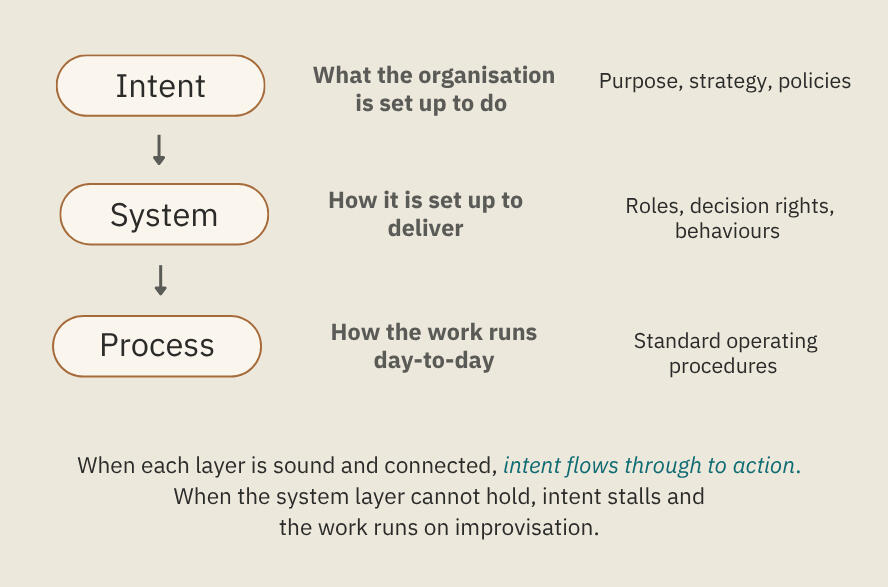
System design is not software. It is how an organisation is set up to do its work: the architecture behind the people. Roles, decision rights, accountabilities, how functions connect, the policy each draws from. When system design is sound, intent flows through to action. When it isn't, leaders end up carrying what should be carried by the system.The condition producing this is rarely the people. It is how the systems inside the function are designed to operate.System Design work addresses the conditions, not the symptoms.
Two ways to engage
Which one fits depends on your situation.
System Design Advisory
If the function is harder to run than it should be but the context is unchanged, the work is System Design Advisory. The systems inside one functional area are captured and improved.System Design Advisory: typically a 90-day advisory engagement focused on one function. Diagnostic, redesign, implementation discipline. Run alongside the operating leader.
Operating Model Design
If the context has totally changed — a new strategy, a regulatory shift, growth that has outgrown the model, a function built for a different reality — the work is Operating Model Design. The model itself is redesigned, from the changed context.Operating Model Design: typically a longer engagement (three to six months). The operating model itself is redesigned with the accountable leader, not just the systems inside it.
Strategy Deployment
When a signed-off strategy is not being delivered by your organisation
Does this describe your situation?Your strategy has been signed off. The Board approved it.
Months later, nothing has actually shifted.
Each part of your organisation is delivering it in its own way.
The work isn't connecting up between teams.
Your customers aren't getting what the strategy promised them.
The strategy is on paper. The organisation is still doing what it did before.The conditions producing this can be redesigned.What this is
Strategy Deployment is design work on a live strategy. It redesigns how the strategy moves through the organisation so each part can deliver its piece and the whole connects.
What changes:
Your strategy actually changes how the work gets done and is delivered to your customers
Every part of your organisation has the systems it needs to deliver its piece of the strategy
Leadership meetings hold the new strategy at the centre of decisions
Improvement work in different parts of the organisation can run at the same time without overwhelming your shared services teams
When the next strategy comes through, your executive team can land it themselves.
Why this is differentMost engagements that look like this from the outside are something else. A strategy refresh, which only changes the words. A restructure, which rebuilds reporting lines but doesn't help the parts of the organisation work together. A leadership programme that works on behaviour without changing what's producing it.This is none of those. It is design to delivery work on a live strategy. The heavy lifting is done in partnership; you hold accountability.
Leadership Support
When leading the work feels harder than the work itself
Are you struggling with this situation?The strategy is set. The decisions are being made.
And still, leading your team takes more out of you than the work itself does.Decisions that should settle a layer or two below keep coming back to you. Agreements made in the room come apart once everyone leaves it. Meetings produce alignment that does not survive the week. More of the coordination runs through you than the design should ever require.Less of your work goes into strategic thinking and leading. More of it goes to holding the place together.None of this means you are the problem. It does mean the work is on two things at once: how the function is set up to run, and how you operate inside it. What you hold, what you let go, how you show up when it is under pressure. Coherence comes from those two holding each other up. Leadership Support works on both, at the executive layer, at the manager layer, or in a leader's own operating practice.Three places this work tends to land
At the executive layer. When the team at the top is not operating as one. Accountability blurs, decisions escalate and the executive itself becomes the coordination mechanism
At the manager layer. When a manager is carrying more of the function than the design should be asking of them, and the way the work is set up underneath needs to catch up
In a leader's own operating practice. When the work is sound but how a leader is holding it is not. Authority, how decisions are made and how they show up under pressure become the conditions producing the strain.
The shape of the work
Most engagements begin with a short conversation. From there, the work takes one of a few shapes. It might be a one-month discovery, with a written finding and a named first move. It might be a 90-day advisory engagement focused on one of the places above. It might run longer, if the work spans more than one layer.The shape is built to where you are. It is always anchored in the same logic: Leadership → Systems → Culture = Coherence.
Contact
If any of this describes your organisation, the first step is a short conversation. It surfaces what is going on and where the work needs to focus.Because the practice works with a limited number of clients at any one time, that conversation is also where genuine fit is established.From there, the next step is clear: a short engagement, a 90-day cycle or a broader conversation about what the organisation needs.
Privacy: Your information will only be used to respond to your enquiry and will not be shared with third parties.
Coherence Co is the trading name of Coherence Co Advisory Limited,
registered in New Zealand. GST registered.
Keep in touch
Coherence Co is a practice for leaders whose organisation is harder to run than it should be. Your strategy is clear, and yet the organisation still cannot turn it into delivery.The list is the practice's primary written channel. New thinking, resources, services and invitations land here first.
Privacy: Your email is held securely in Kit. It is not shared. Unsubscribe any time.
Thank you
Your enquiry has been received. Every enquiry is read personally. You will hear back shortly.
Thanks
A confirmation email via Kit will land in your inbox shortly.
Once you confirm, you are on the list.
You are on the list
The list is the practice's primary written channel.New thinking, resources, services and invitations land here first.